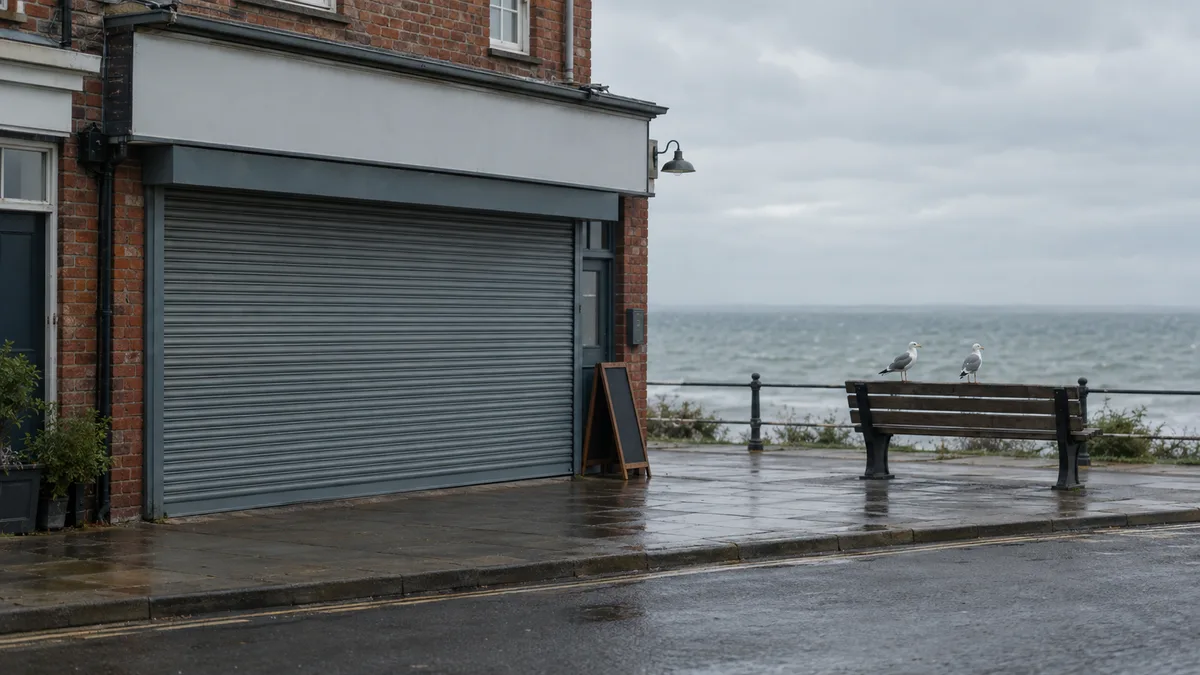
The shutters come down, the listing stays up
The first named storm of the season arrived this week. Storm Austen was named on 20 October 2026 with a yellow wind warning for southern England and south Wales, gusts over 70mph on exposed coasts, and was upgraded to an amber warning for Cornwall, the Isles of Scilly and west Devon the following day. The Met Office's announcements carry the detail. On the Lincolnshire coast the storm lands as the season is already thinning: Lincolnshire's school term dates had Term 1 ending today, Friday 23 October 2026, so the half term that starts tomorrow is the last stretch of the calendar in which the footfall is guaranteed.
After that, winter on this coast is a business decision rather than just a season. The research behind that statement is stark: a 2022 study of the Greater Lincolnshire coastal economy found it to be the most seasonal coastal destination in England for domestic overnight visits, with 94% of domestic overnight spend falling between March and October, 44% of it in July and August alone, against England coastal averages of 84% and 37%. The same study's business survey found only around two-thirds of the coast's businesses open year-round.
So the guides that promise to get your business ready for winter are covering half the job. They write for firms that trade all year, and their lists are about premises: gutters, insurance, pipes, generators. A business on this coast that pulls the shutters down in December has a second list the guides barely touch, and it is the one this piece is about. What does the website say while the door is shut? What does the Google listing do for the closed months? And where does the winter trade that does exist find you, if not through the door?
The answer, worked through below, is two job lists. One is the premises list the guides already cover well, summed up here with the right signposts. The other is the online presence: one honest decision about which winter you are having, made to appear the same everywhere a customer might look.
Decide which winter you are having, then say it everywhere
There are three winters a coastal business can have. The first is fully shut: the doors closed, the season over, reopening at Easter. The second is reduced hours: open fewer days, shorter days, the winter pattern. The third is winter trade: the business that stays fully open because it sells something winter actually brings. Most seafront businesses know which one applies to them by the middle of October. The trouble is that the answer then has to reach everybody. The sign on the door reaches the people who are already there; the website, the Google listing and the social pages have to reach the ones who are not.
Those channels get read by different people at different moments, and they have to agree. A customer who drives to a cafe the listing calls open and finds a roller shutter does not blame the season; they blame the listing, and they do not come back to check again.
What fully shut looks like is not hypothetical here. Lincolnshire Live spent an out-of-season day in Skegness in November 2021 and found a row of seafront businesses already shuttered, seemingly closed until Easter. One market stallholder, Paul Steele, closes on 23 December and reopens in March, and his account of the gap is the blunt one: "January to February are the worst two months. It's dead." That is winter shape one, and it is a reasonable business decision; the failure mode is a website still showing summer hours through all of it.
Winter shape three is smaller than summer but it is real, and it has names and dates. The seal colony at Donna Nook draws visitors from late October to early January, dawn to dusk: the Wildlife Trust's weekly update logged the first pup of the 2025 season on 22 October 2025, a week earlier than 2024, and 1,924 pups in total that season, up 16.6% on 2024's 1,649. The trade that season collects lands up the quiet end of the coast, past Mablethorpe. Winter holiday lets and Christmas and New Year breaks are the other two draws, and the website is where their winter bookings happen.
The shape of the year on this coast, the trade running from Easter to the October lights and thinning hard after, is described on the Skegness page of this site. The dated autumn draws that sit between now and the shutters, half term, the seafront lights and the first seals, are already written up in making the late season count on the coast, so this piece picks up where that one stops.
The Google listing in the off-season
The listing has two dials for reduced opening, and they are for different lengths of closure. Google's help page on hours draws the line at six days: special hours cover temporary changes or closures of up to six days in a row, and a closure of seven days or more, or one of unknown duration, should be marked as temporarily closed instead. A long weekend off in February is special hours. A fortnight's holiday, or a winter shut from Christmas to Easter, is not.
For the full off-season, Google's guidance for seasonal businesses says it plainly: during off-season, you can mark your business as temporarily closed, and when the business reopens you set the regular hours again. The same page allows a business to state its seasonal period in its business description, which matters more than it sounds, because the description is read by customers and by Google alike.
There is a cost to the temporarily closed status, and it is worth knowing before choosing it. Whitespark, a local search firm, tested it in October 2024 and found that marking a profile temporarily closed now has a negative effect on local rankings, a reversal of the position during the pandemic. Their case study is one business, the author's own electrical firm: rankings held steady, dipped when the profile was marked temporarily closed on 23 June and recovered after the status was removed on 28 June. One case study proves a mechanism rather than a magnitude, but the direction is the useful part: the status is not free.
That points at a compromise. Mark the closure honestly, whatever it is; a listing showing open hours for a shut door is the worse failure. Put the reopening pattern in the business description, so a winter searcher reading the listing learns when the doors open again rather than learning nothing. And reopen the profile two to three weeks before the season actually starts, because the first enquiries of a season arrive before the first customers do, and the people planning an Easter break are searching in February and March.
The website while the shutters are down
The site's job in the off-season is to answer three questions with nobody there to answer them in person. What are the hours now? What do things cost now? And when can I book? Each answer belongs on a real page rather than in a photograph, for the reason photographs always fail: a menu board photographed in July is invisible to search engines, and correcting it means editing an image rather than a line of text.
One more line earns its place on the homepage: a dated sentence saying what applies now. "Winter hours from November: open Friday to Sunday", with the date it was written, beats a homepage that says nothing, because it tells both the customer and the search engine that somebody is still tending the place. Change the line when the pattern changes; the date is what makes it believable.
For a holiday let, the off-season is not the closed season at all, and the demand that exists has a shape worth building for. Sykes's figures for winter letting, reported by PropertyWire in November 2024, put numbers on what winter guests book: properties with a hot tub earn on average 37% more, pet-friendly properties earn on average 31% more, and owners accepting shorter breaks can earn around 30% more. The same report notes that 77% of Brits planned a UK break in 2024. None of that pays without an availability calendar that tells the truth and a booking route that works, which is the trade the holiday lets and caravan parks page is written for.
The booking route for next season stays live through the winter too, because next season's bookings are made in this one: the family planning the summer week is browsing in the dark evenings, and a calendar switched off for the winter sends them to the let that stayed bookable. Where the website itself needs work rather than a weekend of edits, a fixed monthly plan keeps it looked after through the closed months instead of leaving the jobs to pile up against reopening; the pricing page sets out what that costs.
Last, test the whole thing the way a winter visitor runs it: on a phone, outside, on whatever signal the seafront offers. Winter visitors check their phones outdoors, on the worst signal the year offers, and a page that loads slowly sends them to the next result. The test takes five minutes and finds the problem while there is still time to fix it.
The storm and flood half, briefly
Half of the standard winter checklist concerns the premises, and that half is covered well by the guides already ranking for this query, so this section sums up and hands over. The jobs are real, most of them are free and several take minutes. Sign up for the Environment Agency's flood warnings: they are free, arrive by text, phone or email, and cover flooding from rivers, the sea or groundwater, though not surface water. The sign-up needs an email address and a contact method available day or night, which is the detail that catches people out; Floodline on 0345 988 1188 takes the registrations by voice instead.
The Environment Agency's business flood plan is a checklist rather than a form, and it asks for the things a flooded business wishes it had written down in advance: trigger points for action, evacuation routes, utility shut-off points, emergency contacts and staff responsibilities. An evening with the template in October is the cheap version of doing it in a flood.
The Met Office's winter preparation list adds the physical jobs: store the 105 power-cut helpline number in your phone, secure loose items against wind, insulate pipes and find the stopcock, and plan for power cuts with charged battery packs. Their small business advice carries the statistic that makes the continuity plan worth an hour: 43% of small businesses have no business continuity, disaster recovery or crisis management plan, and it points to Business in the Community's eight-step guide for writing one. Simply Business's storm plan checklist covers the gutters, drains and insurance claims end of the same list.
The quiet inbox is a target
A business that goes quiet for the winter leaves an email account running unattended for months, and that account is worth money to somebody. The scam that fits the gap is the spoofed supplier invoice, timed to land when nobody is around to notice that the bank details have changed, so the payment goes out in January to an account that was never yours. The pattern, the losses and the phone-call habit that defeats it are worked through in the invoice fraud piece on this site.
Storms bring their own phish. The American consumer regulator warned in January 2026 that scammers follow winter storms with fake utility-company messages. That is American guidance, and the utility names will differ here, but the pattern is the same one UK inboxes see: a message about your power or water supply, arriving just after a named storm, asking for payment. The safe response travels intact: verify through the number on the bill, and never pay by transfer, gift card or crypto.
The first defence against both is a check that takes minutes and can be run from the sofa: the free security check reads your domain's public email records and grades them in plain English, showing whether a criminal could send email as your business. It is passive, touches nothing and asks for no sign-up. If the grade comes back with gaps, the SPF, DKIM and DMARC records that close them are described on the email security page, and the quiet weeks ahead are the right time to set them properly.
One habit finishes the list, and it costs nothing: a second set of eyes on any request to change bank details, however routine it looks and however well it is written. The busy season makes that habit impossible and the quiet season makes it easy, which is as good an argument as any for setting it now.
The questions that come up
Should I mark my business as temporarily closed on Google over the winter? If the business is genuinely shut, yes: Google's off-season guidance says you can mark it temporarily closed and set the regular hours again when you reopen. The alternative, leaving summer hours up while the door is shut, misleads customers every day, which is the worse outcome. Mark it, put the reopening pattern in the business description, and expect the status to cost a little local visibility until it is lifted.
What is the difference between special hours and temporarily closed on Google? Duration. Special hours cover temporary changes or closures of up to six days in a row; a closure of seven days or more, or one of unknown duration, should be marked as temporarily closed instead. A long weekend off in February is special hours. A week's holiday or a winter shutdown is temporarily closed.
Does marking my business temporarily closed hurt my Google ranking? The evidence says it can. A test by Whitespark in October 2024 found the status now has a negative effect on local rankings: one business's stable rankings dipped when the profile was marked temporarily closed on 23 June and recovered after the status was removed on 28 June. It is a single case study, so treat it as direction rather than a measurement, but the direction says to treat the status as a last resort.
How do I get bookings for my holiday let in the winter off-season? Book what winter actually sells: Sykes's figures put it at properties with a hot tub earning on average 37% more, pet-friendly properties earning on average 31% more, and owners accepting shorter breaks earning around 30% more. All of it depends on an honest availability calendar and a booking route that works on a phone in poor signal, which is the part most guides skip.
How do I sign up for flood warnings for my business? Through the Environment Agency's service on gov.uk. The warnings are free, arrive by text, phone or email, and cover flooding from rivers, the sea or groundwater, though not surface water. The sign-up needs an email address and a contact method available day or night, or Floodline on 0345 988 1188 handles it by voice.
What number do I call in a power cut? 105, free, and worth storing in your phone before you need it.
What should I do with my website when my business closes for the season? Make it tell the truth: the winter hours, winter prices and the reopening pattern on real pages, a dated line on the homepage saying what applies now, and the booking route left live for next season's planners. Then test it on a phone on the seafront, where the signal is worst.
What is there for visitors on the Lincolnshire coast in winter? The seals at Donna Nook from late October to early January, winter breaks in the holiday lets and the Christmas and New Year trade. The dated autumn draws that carry the season's final weeks, half term, the lights and the first pups, are listed in the late-season piece.
The quiet weeks are also the time to find out what shape the site behind the listing is in. The check is passive, takes seconds and asks for nothing, and if it finds gaps, the off-season is when there is time to close them.